
To Behold
Fra Angelico, the Magi, and Learning to Behold Again

Do you worship because of what God has done for you? Or do you worship because of who He is? Or perhaps it is both?
Following our wedding, my wife and I spent 3 weeks on our honeymoon in Italy. We spent 5 days in Rome, another 5 in Venice, 3 days in Cinque Terre, and then 3 days in Florence. It was a magical experience to spend three weeks in such a beautiful and historic country. It was Florence that truly made me consider a longer stay. It is a stunning city with beautiful churches, amazing food, and a lively art scene.
Rome, however, will always have my heart. The eternal city is too historic and beautiful not to be my favourite (also the gelato is amazing). But I have written about Rome before, and today I actually want to focus on a particular experience I had in Florence. While we were in Florence, we had the amazing opportunity to go to a special exhibit of the works of the great Fra Angelico. So many of his pieces deeply touched my heart, but there was one unassuming piece that, when my gaze looked onto it, I could not turn away, for it had arrested my eyes and soul in a way that I could not explain.
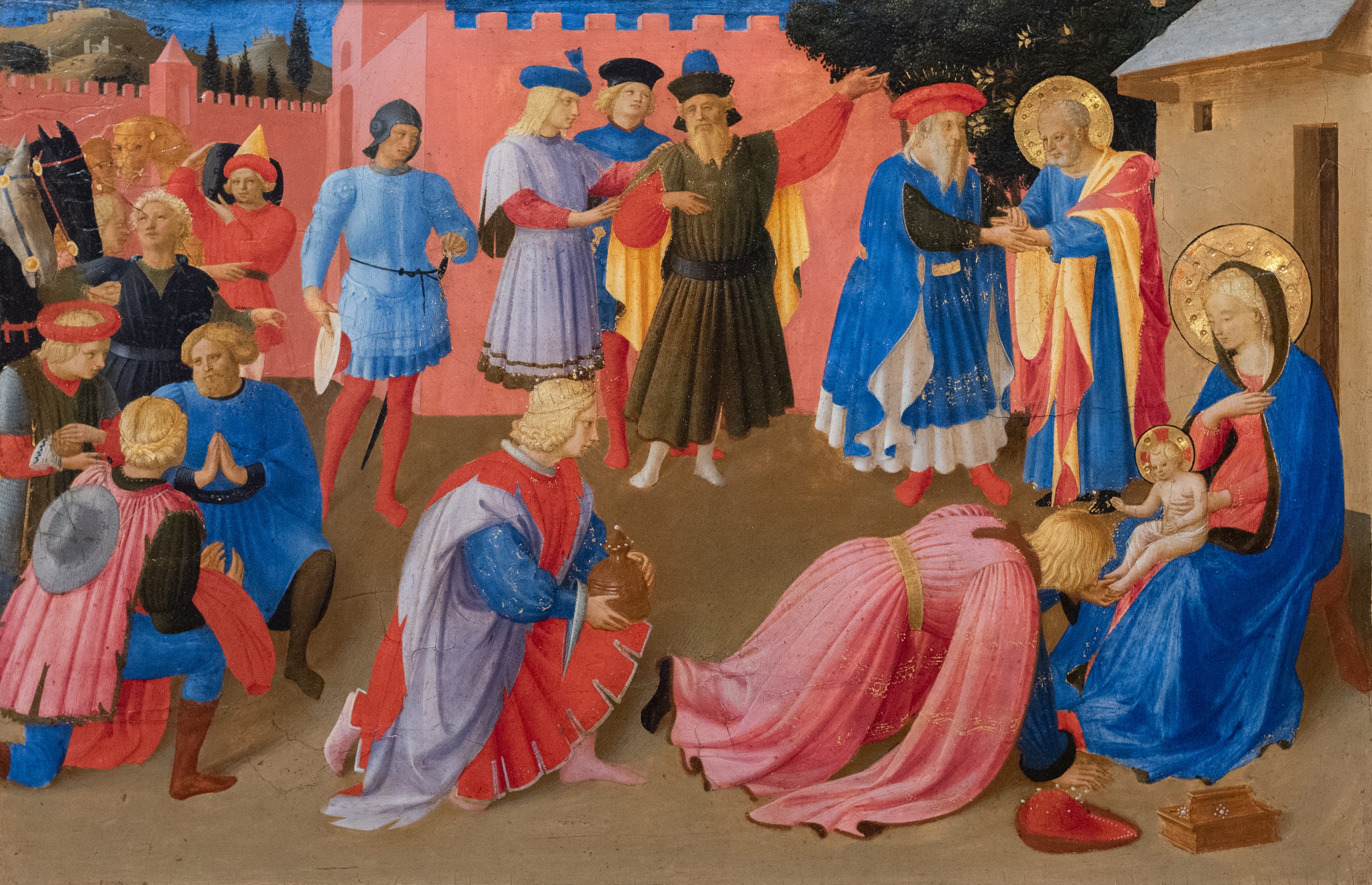
This painting above is the art piece I am referring to and it is part of a larger altar piece known as The Tabernacle of the Linaioli (Italian: Tabernacolo dei Linaioli, literally "Tabernacle of the Linen manufacturers") is a marble aedicula designed by Lorenzo Ghiberti, with paintings by Fra Angelico, dating to 1432–1433. It is housed in the National Museum of San Marco, Florence, Italy.
This painting above is known as The Adoration of the Magi (center of the predella) is recognized as a highly innovative work, showing the Magi kneeling before the Virgin and Child, with a procession following. This is not Angelico’s only depiction, but it is the one I am referring to specifically.
It was Fra Angelico’s depiction of the Adoration of the Magi, pictured above. So small and unassuming, and not something that had been on my radar at all, yet in that moment, as my eyes locked onto it, something arrested me; beauty had captured my soul and moved it deeply in what felt like minutes but was probably just a few seconds. I had been moved by art in a way that has rarely happened to me, and I could not for the life of me figure out why.
This reminded me of what Josh Nadeau once said about art. He expressed something along the lines of how it can arrest your senses and move you in an instant before your mind has even comprehended what it has seen. Yet even after my mind had comprehended the painting, I stood there waiting for my soul to catch up, and after a while found I had no words for what had happened to me. That is, until recently, when I came across these words from Pope Leo the Great:
“And so the wise men saw and adored the Child of the tribe of Judah, “of the seed of David according to the flesh,” “made from a woman, made under the law,” which He had come “not to destroy but to fulfil.” They saw and adored the Child, small in size, powerless to help others, incapable of speech, and in nought different to the generality of human children. Because, as the testimonies were trustworthy which asserted in Him the majesty of invisible Godhead, so it ought to be impossible to doubt that “the Word became flesh,” and the eternal essence of the Son of GOD took man’s true nature: lest either the inexpressible marvels of his acts which were to follow or the infliction of sufferings which He had to bear should overthrow the mystery of our Faith by their inconsistency: seeing that no one at all can be justified save those who believe the LORD Jesus to be both true GOD and true Man.”1
It was in the words: And so the wise men saw and adored the Child of the tribe of Judah, “of the seed of David according to the flesh, “made from a woman, made under the law,” which He had come “not to destroy but to fulfil.” They saw and adored the Child, small in size, powerless to help others, incapable of speech, and in nothing different to the generality of human children. That my soul finally found its answer.
These wise men had travelled to meet a child born in a manger, in a distant land, and they went and worshipped Him. In response to the greatest gift, they worshipped and gave inferior gifts, not because this infant had performed any miracles, but because they believed.
They believed in the prophets of old and their testimonies of what was to come. Just like my soul was stirred by the unknown, and the revelation came only later through the words of St. Leo, so too, I imagine, was the story of the Magi. They carried something within them, a myth, long before the fullness of it was revealed to them in the night sky.
They were, as Rabanus tells us, philosophers of the Chaldeans, men who enquired into the nature of things, men who read the heavens the way scribes read scrolls. And many of them were likely descendants of Balaam, who had prophesied centuries earlier: “A star shall come out of Jacob, and a sceptre shall rise out of Israel” (Num. 24:17).2
The night of Christ’s birth is one that explodes with cosmic celebration. Along with the star that appeared to the Magi, so much happens that it is clear that creation cannot contain its joy in receiving its King. The heavens themselves erupt with angelic praise:
“Glory to God in the highest heaven, and on earth peace among those whom he favors!” (Luke 2:13–14)
This is not a private affair confined to a stable in Bethlehem. Creation responds to the Incarnation with spontaneous exultation.
If you're new to The Altar of Moriah, welcome. My name is Corné Gieselbach. I'm a theologian, author, and Chair of the Undergraduate program at TheosSeminary, with a PhD candidacy in historical dogmatics beginning this October. I publish every Monday. Paid subscribers receive every post alongside behind-the-scenes and workshop content. Free subscribers receive bi-weekly essays. If this piece resonates, consider subscribing to support the work.
The Old Testament prophets anticipated this moment through imagery of universal rejoicing. The heavens are commanded to be glad, the earth to rejoice, the sea to roar, and the trees of the forest to sing for joy (Ps 96:11–13) all because the Lord is coming (Ps 96:11–13). Mountains, forests, and every tree break forth into singing (Isa 44:23), while the mountains and hills burst into song, and all the trees clap their hands (Isa 55:12). The early church understood these passages as directly illuminating Christ’s arrival.
The early Christians prayed Psalm 96 as referring to the Incarnation, understanding that the appearance of the King into the world brings joy to the whole earth, a message echoed by the angels at Jesus’s birth, announcing “good tidings of great joy which will be to all people.”3
St. John Chrysostom captured this explosion when he wrote on this moment:
“This was manifestly not one of the common stars of Heaven. First, because none of the stars moves in this way, from east to south, and such is the situation of Palestine with respect to Persia. Secondly, from the time of its appearance, not in the night only, but during the day. Thirdly, from its being visible and then again invisible; when they entered Jerusalem it hid itself, and then appeared again when they left Herod. Further, it had no stated motion, but when the Magi were to go on, it went before them; when to stop, it stopped like the pillar of cloud in the desert. Fourthly, it signified the Virgin’s delivery, not by being fixed aloft, but by descending to earth, shewing herein like an invisible virtue formed into the visible appearance of a star.”4
To the Shepherds, Angels, and the Magians, a star points out Christ; to both speaks the tongue of Heaven, since the tongue of the Prophets was mute. The Angels dwell in the heavens, the stars adorn it, and to both therefore the heavens declare the glory of God. The Sheperds are told by an Angel yet it is this star that brings the Magi.
When they arrive at the manger and behold the infant Jesus. The star spoke their language. This is worth pausing over. God did not send the Magi a prophet or an angel like in the case of the sheperds. As St. Gregory observes, to the Jews who used their reason, a rational creature, an Angel, was sent to preach. But to the Gentiles, who did not yet know how to use their reason in this way, God gave signs rather than words. Speaking preachers proclaimed a speaking Lord; mute signs proclaimed a mute infant.5
There is a profound condescension in this. God meets the Magi exactly where they are, in the only language they know how to read, and through it draws them toward a reality that will shatter every category they brought with them. They did not need to understand everything before they could obey. They needed only to recognise that something had been revealed, and to follow it.
And follow they did. They left their homeland, crossed the desert, and came to Jerusalem, the royal city where, by every reasonable expectation, a king should be born. But He was not there. And what they found instead is one of the most quietly devastating contrasts in all of Scripture. The Magi, Gentile stargazers with no birthright and no covenant, sincerely wished to pay homage to the King of the Jews.
Herod, who claimed that very title, sought to destroy Him. The scribes and chief priests could name the place of His birth from the prophets, but would not walk the short road to see for themselves. St. Augustine’s image has never left me since I first encountered it: the Jews who directed the Magi to Bethlehem were like carpenters who built the Ark of Noah in order to provide others with the means of escape, while allowing themselves to perish in the flood. Herod had all the knowledge of Scripture, and yet he did not seek Jesus.
The Magi searched in the darkness without it but were willing to travel extraordinary distances to meet a king of whom they had only the faintest knowledge. Herod had so much and gave nothing. The Magi had only what they could carry, and they gave everything.
The real issue, as William Danaher rightly notes, is not what birthright one has, but what kind of disciple one seeks to become in light of the revelation of Christ, however faint that revelation might be.6 And this is where the Magi begin to teach us something about obedience. They obeyed what had been revealed to them. All they had was a star, an ancient prophecy from Balaam, and the uneasy confirmation of hostile scribes. Yet, through that obedience, incomplete and groping as it was, they found what they were looking for.
They arrive in a golden courtroom within the inner sanctum of a palace; instead, they arrive before a mother holding an infant. Chrysostom asks the question that should haunt us: “If the Magi had come in search of an earthly King, they would have been disconcerted at finding that they had taken the trouble to come such a long way for nothing.” But since they sought a heavenly King, though they found in Him no signs of royal preeminence, yet, content with the testimony of the star alone, they adored for they saw a man, and they acknowledged a God.7 There was no purple robe, no crown, no army, no fame of battles. There was a child, small in size, powerless to help others, and they worshipped Him.
And they gave gifts. Gold, frankincense, and myrrh. Fine things. Costly things. But infinitely beneath the One who received them. St. Gregory reads the gifts as something like a sacramental self-offering: gold signifies the lustre of wisdom offered to the King; incense signifies the fervour of prayer ascending to God; myrrh, used in embalming, signifies the mortification of the flesh offered to the One who would die for the salvation of all.
The gifts are acts of recognition and gestures that say, " We know who You are, and that is enough.” We tend to give a person the gift we believe they deserve. The Magi looked at an infant lying in a manger and gave Him gold fit for a king, incense fit for God, and myrrh fit for the One who would lay down His life for the world. That is what they believed He deserved. And He had not yet done a single thing.
This is the confrontation the Magi bring to every one of us. Danaher presses the point, and I think he is right: the Magi’s gifts are a response to the greater gift of the Christ child Himself. As an expression of God’s infinite generosity, in which God actually gives God’s self, there is no way to enter the economy established by Christ as equals. There is nothing we can offer that matches what has been given.8 The Magi seem to have understood this instinctively. Their gifts were acts of surrender to reality itself received.
We have received infinitely more than they had. We have the full testimony of Scripture. We have two thousand years of saints who have walked this road before us. We have the sacraments. We have the indwelling of the Holy Spirit. We have the completed story. The Magi had none of this. And yet they fell down and worshipped.
They worshipped an infant who had done nothing for them. He had not healed their sick. He had not calmed their storms. He had not spoken a single parable or offered a single promise. He had not yet stretched out His arms on the cross or conquered death. And they knelt. Chrysostom marvels at this:
“They had not even seen Christ yet, and they were prepared to die for Him. They became confessors of Christ in the presence of a most cruel despot even before they had seen Him do anything.”9
I wonder how often we can say the same. So much of our worship is conditioned by return. We praise God when He answers our prayers. We thank Him when He provides. We sing with fervour when the blessings are fresh and visible. And we should. Scripture itself commands it:
“Bless the Lord, O my soul, and do not forget all his benefits” (Ps. 103:2).
There is nothing wrong with gratitude for what God has done. But there is something incomplete about a faith that only worships in response to benefit. And if we are honest, truly honest, many of us will recognise that we come to God more often as consumers than as contemplatives. We come because we need something. We stay because we have received something. And when the receiving slows, we drift.
The Magi did not worship because God had acted on their behalf. They worshipped because God had come. The gift was not something He gave them. The gift was Himself. And they recognised, with a faith that I find staggering, that this was enough.
Evelyn Underhill once wrote that the essence of the story of the Magi is that it is no use to be too clever about life. Only insofar as we find God in it do we find any meaning in it.10 She is right, and I think the reason she is right is that the Magi’s journey is the shape of the contemplative life itself. You receive a sign you do not fully understand. You obey. You travel through uncertainty, carrying only what has been revealed to you and trusting that it is enough to guide you. You arrive and find not what you expected but something infinitely greater in its smallness. And you kneel.
This is what the Christian tradition calls contemplation, and it is, I fear, one of the things we have most thoroughly lost. We have become a people of activity, people of programmes, strategies, spiritual growth plans, worship sets designed to produce particular emotions at particular moments. And none of these are necessarily bad things. But somewhere beneath all of it, there must be a place where we simply stop.
Where we bring nothing. Where we ask for nothing. Where we sit beneath the gaze of God and let Him be God without requiring Him to prove it.
Underhill wrote that meditation on the Christian mysteries is so nourishing to the soul, and so inexhaustible as a basis of prayer, precisely because these events are indwelt and moulded by the Divine Charity. They do not yield their meaning to the impatient or the clever. They yield it to those who are willing to sit with them, to chew the cud of the Gospels, as she puts it, and to let the mystery work at its own pace.
The Magi did not come with a list of requests. They came because a star had told them that the King had been born, and they wanted to see Him. Not to use Him. Not to leverage Him. Not to extract a programme from His presence. They came to behold. And through that beholding, they found what they were looking for.
I think Fra Angelico understood this. That small, unassuming painting in Florence, the Adoration of the Magi on the predella of the Linaioli Tabernacle, arrested me because it captured something my soul already knew but had not yet found words for. The Magi kneeling. The child is simply present. No transaction. No negotiation. Just the infinite condescension of God becoming small enough to be held, and the staggering faith of men who crossed the world to kneel before Him. My soul was stopped that day in Florence. And in that stopping, in that moment of pure, unlooked-for beholding, I think I tasted something of what the Magi knew.
The Word became flesh. He is here. And that is enough.
-Corné
Pope Leo the Great, “Sermons,” in Leo the Great, Gregory the Great, ed. Philip Schaff and Henry Wace, trans. Charles Lett Feltoe, vol. 12a, A Select Library of the Nicene and Post-Nicene Fathers of the Christian Church, Second Series (New York: Christian Literature Company, 1895), 148–149.
St. Thomas Aquinas. Catena Aurea: Commentary on the Four Gospels, Collected out of the Works of the Fathers: St. Matthew. Edited by John Henry Newman. Vol. 1. Oxford: John Henry Parker, 1841.
Patrick Henry Reardon, Christ in the Psalms (Chesterton, IN: Ancient Faith Publishing, 2000), 191–192.
St. Thomas Aquinas, Catena Aurea: Commentary on the Four Gospels, Collected out of the Works of the Fathers: St. Matthew, ed. John Henry Newman, vol. 1 (Oxford: John Henry Parker, 1841), 67.
Gregory the Great, in Thomas Aquinas, Catena Aurea: Commentary on the Four Gospels, ed. John Henry Newman, vol. 1 (Oxford: John Henry Parker, 1841), 64.
William J. Danaher Jr., "Theological Perspective on Matthew 2:1–12," in Feasting on the Word: Preaching the Revised Common Lectionary: Year C, ed. David L. Bartlett and Barbara Brown Taylor, vol. 1 (Louisville, KY: Westminster John Knox Press, 2009), 212.
John Chrysostom, in Aquinas, Catena Aurea, vol. 1, 67. Cf. Thomas Aquinas, Summa Theologiae III, q.36, a.8, ad 4, ed. The Aquinas Institute, trans. Laurence Shapcote, vol. 19 (Green Bay, WI; Steubenville, OH: Aquinas Institute; Emmaus Academic, 2018), 388.
Danaher, "Theological Perspective on Matthew 2:1–12," 214.
John Chrysostom, in Carthusian Ludolph of Saxony, The Life of Jesus Christ, trans. Milton T. Walsh, vol. 1, Cistercian Studies Series (Collegeville, MN; Athens, OH: Liturgical Press; Cistercian Publications, 2022), 209.
Evelyn Underhill, The School of Charity: Meditations on the Christian Creed (London; New York; Toronto: Longmans, Green and Co., 1934), 43.
Insightful and interesting. Thank you
This reminded me of Psalm 27:4 and I love it! Thanks for the reminder to sit and behold without asking for anything. Just enjoying the beauty of our Lord.