

What Our Words Reveal
Take away the word, and what is left but water?

One of the privileges of my vocation as a teacher in a seminary is the responsibility of carrying theological influence that can guide fellow believers’ understanding of God. This is not a responsibility I take lightly, for it is a double-edged sword.
As teachers at any level, we have the power to guide someone into divine revelation, but also the power to deceive them. That is why St. James warns us in James 3 of wanting to become teachers:
3 Not many of you should become teachers, my brothers and sisters, for you know that we who teach will be judged with greater strictness. 2 For all of us make many mistakes. Anyone who makes no mistakes in speaking is perfect, able to keep the whole body in check with a bridle. 3 If we put bits into the mouths of horses to make them obey us, we guide their whole bodies. 4 Or look at ships: though they are so large that it takes strong winds to drive them, yet they are guided by a very small rudder wherever the will of the pilot directs. 5 So also the tongue is a small member, yet it boasts of great exploits. How great a forest is set ablaze by a small fire!
If you’re new to The Altar of Moriah, welcome! My name is Corné Gieselbach. I’m a theologian, author, and Chair of the Undergraduate program at TheosSeminary, with a PhD candidacy in historical dogmatics beginning this October. I publish every week on Monday, Wednesday and Friday. Paid subscribers receive every post; this includes Academy posts and devotional posts. Free subscribers receive weekly Wednesday essays. If this piece resonates, consider subscribing to support the work.
The cliché of “with great power comes great responsibility” comes to mind. There is a great power within the tongue; James compares it to a small spark that can easily set a whole fire ablaze. Now, often when people talk about the power of the tongue, they might dive into an exposition of James 3, but today I actually want to look at the ontological nature of words themselves.
Now I first have to clarify a category of teachers here. Not all of us are teachers in the same way, but we all are teachers in a way. Stay-at-home mothers are the teachers of their kids, and just like a seminary professor can lead someone closer to God or further away from them, so too can the mother influence the salvation of the eternal souls of her kids.
Some people just teach at a larger scale with a larger influence, meaning that instead of the 4 kids at home, they have 400 church members who rely on their guidance to understand the ways of God, and this teacher will be held accountable for every word they utter to every single soul who hears them.
No wonder James issues this warning. In words there is the power to create and the power to destroy. Think about it. In biblical theology, God initiates all speech by speaking creation into existence. God is the first one to speak in the Bible; he “speaks” (אָמַר, ʾāmar) and brings forth the entire created realm (Gen 1:3, 6, 9, 11, 14, 20, 24). People also possess the ability to speak and communicate with one another (Gen 4:8) and God (Gen 3:10, 12). The theological emphasis in the Bible is that a right way to use one’s speech exists.1
Speech is used properly when it aligns with the nature of God and his commandments. This can be seen in the Decalogue, where some transgressions involve improper use of one’s speech (Exod 20:7, 16). Some things should and should not be said, and when speech is performed in concert with God’s moral will, an act of worship occurs.
If, as Paul says in 1 Cor 10:31, all human activity has the glory of God as its aim, then all speech that detracts from this aim would be improper—what the Bible calls sin. What makes speaking “improper” or “proper” depends on the intent and motivation of the human heart.
And if we are to understand human intent, we have to see it through the Incarnation. It is through God’s Word that the world came into being for His glory, and it is through the Word made flesh that a fallen world is now being recreated into its original, glorified form.
This statement reveals two things to us for our context. We are a fallen humanity that can create and destroy through our speech, and that the words we choose are both influenced by something and directed towards something. The key difference being that before Christ there was no real way to consistently choose life, but through the incarnation Christ has come to redeem speech itself.
The language of faith teaches us about living the life of faith. This dynamic flows from the logic of the Incarnation: human words can reveal the truth about the Word made flesh, and so conform us to Christ.
The believer is obliged, then, to employ the language of faith, and to do so, moreover, with a confidence that comes from his own personal adherence to the truth. In morals, the language of faith expresses not only the commandments and the teachings of the Church, but also the vocabulary of the virtues, which translates what the Church teaches into the everyday, and easily recognisable, circumstances of human life.2
The Church and our faith have a vocabulary, and the clearest form of this we see is within the liturgies of the Church, which finds its form within the liturgy of the Israelites.
I mentioned earlier that one of my great joys of being a teacher is that I get to guide students in their thinking. One of the most consistent ways I have done this has been through conversations with pastors on the Eucharistic liturgy.
I wrote my book The Living Banquet exactly because I was having these conversations so regularly that I thought it was just easier to write my answers down for people to consult on their own.
Recently I was asked by my friend, Christian, about the “form” of the liturgy. By form I mean the prescribed, established words and ritual actions used to conduct public worship. Form goes together with the "matter" (the physical elements like bread, wine, or water), and the correct use of both is required for liturgies and sacraments to be validly celebrated.
The classical expression of this understanding of matter and form as, respectively, “potency” and “act” in the sacraments comes from St. Augustine, who, speaking of Baptism, says:
Take away the word, and what is the water except water? The word is added to the elemental substance, and it becomes a sacrament, also itself, as it were, a visible word.… Whence is this power of water of such magnitude that it touches the body and yet washes clean the heart, except from the word’s effecting it, not because it is said, but because it is believed? For also in the word itself the passing sound is one thing, the abiding power another.3
This power operates on multiple levels. First, words carry signification more precisely than material things, whose meaning is largely given and often ambiguous—words pin down what things cannot specify on their own. Water, in the first century, for instance, can symbolise life, purification, or danger. It is only through the spoken formula of “I baptise you” that it is clarified that water functions as a sign of purification in baptism.
Beyond mere clarification, the word operates theologically. The fathers drew an analogy between the Incarnation and sacraments—as the Word was joined to palpable flesh in Christ, so a word is added to a palpable element to constitute a sacrament.
The water touches the flesh and cleanses the heart. It cannot do this, of course, by its aquatic properties alone, but rather inasmuch as it is accompanied by the word. The word is added to the element, and the sacrament is formed, which is like a visible word (accedit verbum ad elementum et fit sacramentum, etiam ipsum tamquam uisibile uerbum).4
Note that the word, here, is not composed of matter and idea only, but also of matter and communicative force: it is a saving word, a word of vocation or promise; it is the word of faith, capable of transforming the one who receives it. And it is this transformative power I want to hone in on.
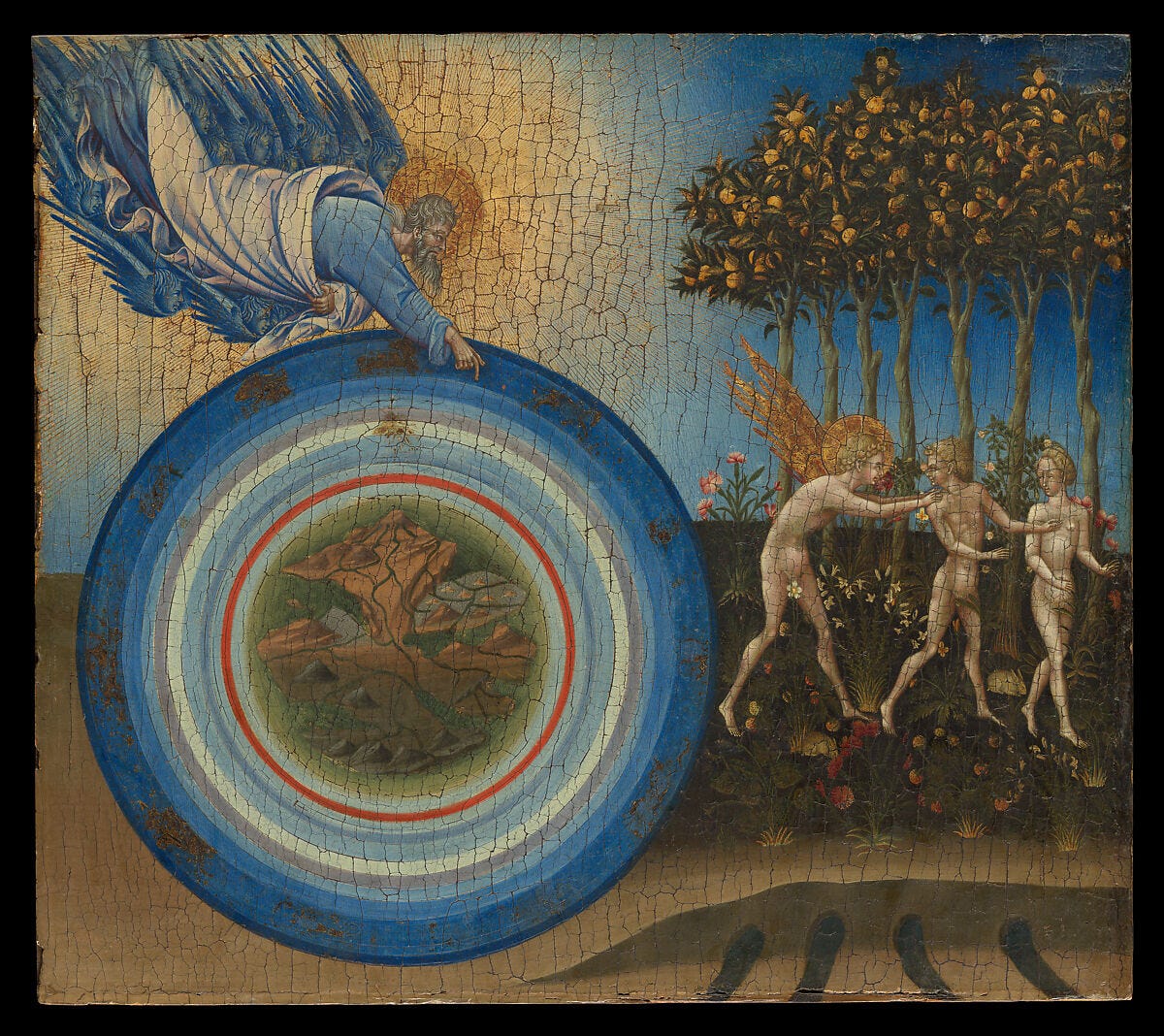
We can try to better understand this reality by borrowing a patristic axiom. This axiom is the aproslepton, atherapeuton, “that which was not assumed was not healed.” Christ assumed our human voice and therefore redeemed it. This means that human language has been redeemed and filled with new meaning and power. This implies the importance of learning from the words of the incarnate Word.
St. Gregory of Nyssa articulates why God employs words at all. Since finite human nature cannot grasp the superior nature of the Most High, God brings divine power down to the level of human weakness, bestowing grace through words—adapting himself to humanity like a tender mother joining in her child’s utterances, so that through feelings corresponding to our own we might lay hold of the Divine nature by means of the words which His foresight has given.
For as by Divine dispensation the sun, tempering the intensity of his full beams with the intervening air, pours down light as well as heat on those who receive his rays, being himself unapproachable by reason of the weakness of our nature, so the Divine power, after the manner of the illustration I have used, though exalted far above our nature and inaccessible to all approach, like a tender mother who joins in the inarticulate utterances of her babe, gives to our human nature what it is capable of receiving; and thus in the various manifestations of God to man He both adapts Himself to man and speaks in human language, and assumes wrath, and pity, and such-like emotions, so that through feelings corresponding to our own our infantile life might be led as by hand, and lay hold of the Divine nature by means of the words which His foresight has given.5
This patristic vision of speech stands remarkably close to James. For the fathers, idle talk and an empty mind do not stay confined to the lips; they spread into our actions and finally into the whole shape of a life. It is the same logic James follows: the one who can bridle his tongue governs his whole body, while the one who indulges the tongue soon finds his conduct following after it.
This is why speech must be handled with such care. Its origin is divine, its beginning in the world solemn, yet its effects on others and on ourselves are genuinely dangerous. It is to be spent only on objects worthy of it, never squandered on lying, slander, or quarrelling.
Rightly used, speech becomes a living echo in us, of the Word of our Creator; a bright expression of our purified nature; a powerful organ of our empire over other creatures.
Here, then, is why the fathers insisted so strictly on sacramental form. The precise words of the liturgy are not arbitrary formulae, still less magic syllables that coerce grace.
They are redeemed utterances — human speech assumed by the Word and now able to align human action with divine intention. And what is true at the altar is true, in its measure, every time we open our mouths.
For this is finally the point. We are formed by what we speak. Our words do not merely report the state of our hearts; they shape it — and they shape the hearts of everyone within earshot. James saw this. The tongue that blesses God and curses those made in His likeness betrays a divided heart, and a divided heart cannot stay hidden, because it keeps speaking.
So the question every believer must ask is not only whether our words are true or false, kind or cruel. But are we speaking the speech of God, or the speech of the world?
Our words are diagnostic. They tell us who we are and where our treasure lies; they are among the surest signs of our spiritual health. “Out of the abundance of the heart the mouth speaks.” (Matthew 12:34).
However, the same Word who assumed our flesh assumed our voice, and what He assumed He has healed. Our speech has been redeemed at its root. The liturgy rehearses that redemption week by week, teaching our tongues the vocabulary of heaven so that, slowly, our ordinary words might be conformed to it.
We learn to speak as children do, by listening, and the Church, joining her inarticulate children in their utterances, teaches us to say after her the words His foresight has given.
Take away the word, and what is left but water? Add the word, and there is a sacrament. Add the Word, and there is a world made new.
-Corné
Preston Lee Atwood, “Speaking,” in Lexham Theological Wordbook, ed. Douglas Mangum et al., Lexham Bible Reference Series (Bellingham, WA: Lexham Press, 2014).
Romanus Cessario, Theology and Sanctity, ed. Cajetan Cuddy (Ave Maria, FL: Sapientia Press, 2014), 177–178.
Augustine, Tractate 80.3 (on John 15:3) (Rettig, Tractates on the Gospel of John 55–111, 117–18). In Lawrence Feingold, The Eucharist: Mystery of Presence, Sacrifice, and Communion (Steubenville, OH: Emmaus Academic, 2018).
José Granados, Introduction to Sacramental Theology: Signs of Christ in the Flesh, trans. Michael J. Miller (Washington, D.C.: The Catholic University of America Press, 2021), 186–187.
St. Gregory of Nyssa, “Answer to Eunomius’ Second Book,” in Gregory of Nyssa: Dogmatic Treatises, Etc., ed. Philip Schaff and Henry Wace, trans. M. Day and William Moore, vol. 5, A Select Library of the Nicene and Post-Nicene Fathers of the Christian Church, Second Series (New York: Christian Literature Company, 1893), 292.
Fantastic. You’re friend Christian sounds cool.
Beautiful writing around the importance of our words and what we speak xx