
All Influence Is Immoral
(Unless It Is Christ)

It has been said that we tend to see ourselves as the heroes of Scripture. We see ourselves as David toppling Goliath, as Moses leading the Israelites out of Egypt, as prophets calling the people of God back to His commandments. These passages often confirm to us the call of God on our lives that we feel and sense our hearts desiring. This is not inherently a bad thing, and I would argue it is even useful.
I would, however, caution against this if we cannot see ourselves in the failures of Scripture. As Jonah fleeing God, as Samson giving into our desires despite God’s instruction, as David with Bathsheba. The danger in seeing our strength without our weakness is that it blinds us from the real hero of Scripture, God.
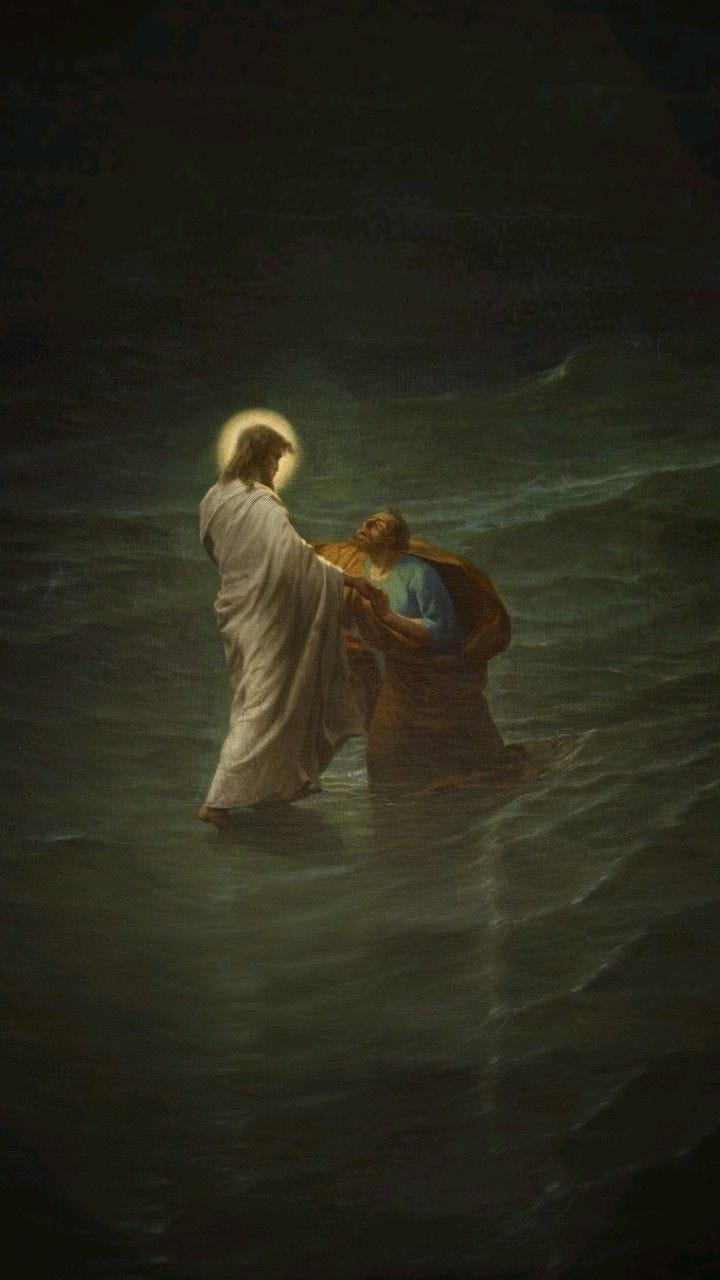
One of these passages of Scripture that reminds me of my weakness is Matthew 14:22–33 where Peter walks toward Jesus on the water. In the midst of a big storm out on the water, which in the 1st century was seen as a symbol of chaos and lawlessness, already petrified, Christ comes walking on water towards His disciples. It is then that Peter, in an attempt to be like his teacher, calls out to Jesus and initiates his moment of obedience. Peter says to Jesus that if it is Him, He should call out to him and he will meet Christ on the water.
Jesus calls Peter to step out onto the stormy waters, and while his eyes were on Christ, he remained above the water, yet the moment he was distracted and fear-struck by the waves, Peter begins to sink. It is a moment we can all relate to and immediately understand. Keep your eyes on Christ, and you won’t sink; keep your eyes on the storm, and you will succumb to it. Yet, the added context of understanding that in Hebraic thought, water represented far more than physical reality; whether the sea with its unfathomable depths or the all-consuming deluge, there exists something metaphysical about the threat water poses to human life.
According to Karl Barth, water in the first biblical creation story is “the principle which, in its abundance and power, is absolutely opposed to God’s creation,” representing “all the evil powers which oppress and resist the salvation intended for the people of Israel.”1
Recently, I have been reading through the book of Sirach, and chapter 3 stood out to me in a way Scripture rarely has. Particularly verse 20-24:
20 For great is the might of the Lord; but by the humble he is glorified. 21 Neither seek what is too difficult for you, nor investigate what is beyond your power. 22 Reflect upon what you have been commanded, for what is hidden is not your concern. 23 Do not meddle in matters that are beyond you, for more than you can understand has been shown you. 24 For their conceit has led many astray, and wrong opinion has impaired their judgment. - NRSV Sirach 3:20–24.
This passage illuminated to me a truth about human life, and this story about Peter that I had heard many times, yet never fully understood. There is a contrast within these 4 verses that speak to a sickness within us. A sickness that has thrived in this age of social media and platforms. This contrast shows us the weakness of our humanity and the sovereignty of God.
There is this assertion that what God has revealed to us as our calling, our daily work, our commitments, and our dreams are already more than we can personally handle. Yet, because of the grace of God, we are given the means to handle it. It is His grace that reveals to us what we are called to, and it is His grace that sustains us in it.
Galatians 6 puts this into clearer perspective and illuminates another danger to us:
4 All must test their own work; then that work, rather than their neighbour’s work, will become a cause for pride. 5 For all must carry their own loads.- NRSV Galatians 6:4–5.
Sirach and Galatians speak to the reality that we already have enough on our plates, yet when we start to look at the plates of our neighbour and compare ourselves to them, or desire things on their plate, or even when we try to stick our nose in plates that are not our own, we become prideful not in the work we have done in worship to God, but prideful in comparing ourselves to others and this leads us astray.
Like Peter, instead of walking towards Christ, we are focused on the things that are trying to consume us, and we give no care for our souls. We are deceived not merely in giving up our attention span to things that are not ours, but in holding up Sirach with the story of Peter, we realise we are giving our attention to the demonic instead of to God. And in return, our souls are starved, and so is our calling.
St. Augustine spoke about this, too:
“And men go about to wonder at the heights of mountains… but themselves they consider not.”2
He understood that searching beyond what is revealed to us is a fool’s errand. And fools influence others to do the same. Whether you like it or not, you exert some form of influence on those around you, and if you are not careful, you might cause your brother or sister to stumble.
In Oscar Wilde’s The Picture of Dorian Grey, he writes the following about influence.
“There is no such thing as a good influence, Mr. Gray. All influence is immoral—immoral from the scientific point of view.”
“Why?”
“Because to influence a person is to give him one’s own soul. He does not think his natural thoughts or burn with his natural passions. His virtues are not real to him. His sins, if there are such things as sins, are borrowed. He becomes an echo of some one else’s music, an actor of a part that has not been written for him. The aim of life is self-development. To realise one’s nature perfectly—that is what each of us is here for.”3
Wilde understood the modern anthropology of self-authorship long before we baptized it as “authenticity.” For the Christian, if we were to consider these words to be accurate, it becomes troublesome if we are not intentional. The Church has never rejected influence; she rejects possession. Influence becomes holy only when it mediates Christ rather than the self.
In previous essays, I have written about how the road towards sanctification is walked through the faithful everyday obedience to what God has given you. The path to reclaiming the imago dei within you is through becoming Christlike, a role that is written for all of us.
So if our influence in this world is not tainted by our distraction but perfected through our faithfulness, we influence those around us not by giving them our soul but the heart of God. And the part they are then called to play is that of Christlikeness.
But when we influence those with our own souls, we give them a part of us that does them no good, but also leaves us empty. St Bernard of Clairvaux writes:
“If then you are wise, you will show yourself rather as a reservoir than as a canal… The canal spreads abroad water as it receives it, but the reservoir waits until it is filled before overflowing.”4
There is a lot of noise out there, and sadly, it feeds the fleshy part of us that desires more than what God has given to us, and so we must tame it; otherwise, it will tame us and wickedness will rule our lives.
I leave you with the last words of St. Basil the Great:
“I know not how I can address you except as a Christian, for I desire no other name, and I am content with that. If you take this from me, all else is empty.”5
Basil’s final self-understanding collapses all other names and roles into one: Christian. Not a hero. Not influence. Not brand. Not narrative. Only Christ.
In Christ,
Corné
Iwan Russell-Jones, “Theological Perspective on Matthew 14:22–33,” in Feasting on the Word: Preaching the Revised Common Lectionary: Year A, ed. David L. Bartlett and Barbara Brown Taylor (Louisville, KY: Westminster John Knox Press, 2011), 334.
St. Augustine Confessions, Book 10, Chapter 8
Oscar Wilde, The Picture of Dorian Gray, ch. 2 (HarperCollins ed., p.16).
St. Bernard of Clairvaux, Sermon 18 on the Song of Songs
St. Basil of Caesarea, Letter 345, To Terentius
This is full of wisdom and I cannot sometimes believe that you are only 23. Well written. Thank you for this.