
The Indisputable Dirt
Why we still need a physician

Whether we know it or not, we are all terminally sick. We have all received the diagnosis of Original Sin. Our only hope is to fling ourselves at the foot of the cross, to repent and be baptised, so that in the waters of baptism the old self might be put to death, so that the disease might lose its dominion. While still present within us, it has now been deprived of its rule. The danger of relapse remains; all it requires is the slow consent of unrepentance for the sickness to begin asserting itself again.
Baptismal cleansing is but step 1 in the treatment of this terminal disease. Daily medication of repentance and regular receiving of what St. Athanasius called: “The medicine of immortality,” the Eucharist, is the prescription given to us by the Great Physician Himself. Christ often ties sickness to sin and faith and repentance as the cure.1 The greek word for saving and healing is the same, and I believe that this is because salvation is more than just right standing with God. It is the ongoing process of receiving treatment through grace for a terminal illness that will one day be cured.
Chesterton believed that there was one Christian doctrine that could be irrefutably proven, that was the doctrine of original sin.
“But certain religious leaders in London, not mere materialists, have begun in our day not to deny the highly disputable water, but to deny the indisputable dirt. Certain new theologians dispute original sin, which is the only part of Christian theology which can really be proved.”2
“By its nature the evidence of Eden is something that one cannot find. By its nature the evidence of sin is something that one cannot help finding.”3
“If he had begun with the human soul—that is, if he had begun on himself—he would have found original sin almost the first thing to be believed in. He would have found, to put the matter shortly, that a permanent possibility of selfishness arises from the mere fact of having a self, and not from any accidents of education or ill-treatment.”4
To Chesterton, to be human was to have original sin. This idea is rooted in the early church writings of St. Augustine, where, in His book Confessions, he comes to the conclusion of original sin by observing his own behaviour as an infant. He writes:
“The weakness then of infant limbs, not its will, is its innocence. Myself have seen and known even a baby envious; it could not speak, yet it turned pale and looked bitterly on its foster-brother. Who knows not this? Mothers and nurses tell you that they allay these things by I know not what remedies. Is that too innocence, when the fountain of milk is flowing in rich abundance, not to endure one to share it, though in extremest need, and whose very life as yet depends thereon? We bear gently with all this, not as being no or slight evils, but because they will disappear as years increase; for, though tolerated now, the very same tempers are utterly intolerable when found in riper years.”5
St. Augustine’s point is not that society creates morality, but that it restrains what it cannot cure. The selfishness present in the infant does not disappear as we age; it is trained and concealed. Civilization moderates our behaviour, but it does not heal our desire. We learn to live together because we learn how dangerous we are to one another. What we call moral progress often means that our disorder has only become manageable via the social contract.6
This is but one of the theses we must consider in how original sin interacts with society.
There is also a different theses proposed in Oscar Wilde’s novel, The Picture of Dorian Gray. In this novel, the story frames beauty as the only thing worth having, and pleasure as the only thing worth seeking.
“To be good is to be in harmony with one’s self, he replied, touching the thin stem of his glass with his pale, fine-pointed fingers. “Discord is to be forced to be in harmony with others. One’s own life-that is the important thing. As for the lives of one’s neighbours, if one wishes to be a prig or a Puritan, one can flaunt one’s moral views about them, but they are not one’s concern. Besides, Individualism has really the higher aim. Modern morality consists in accepting the standard of one’s age. I consider that for any man of culture to accept the standard of his age is a form of the grossest immorality.’7
The character in question, Lord Henry, rejects morality rooted in shared human obligation and replaces it with aesthetic authenticity, where goodness becomes fidelity to the self rather than responsibility toward reality. Lord Henry is encouraging indulgence and dismantling obligation. If goodness means harmony with oneself, then any demand placed upon me from outside becomes violence, and society itself becomes the source of guilt.
The social contract, in this vision, does not preserve human life together but suppresses authentic existence, because it assumes our desires must answer to a shared human order.
Yet this is precisely where the tension appears: the social contract exists because we repeatedly injure one another, while individualism exists because we resent being restrained. The novel exposes the modern oscillation between these two instincts, either morality is imposed by society or invented by the self, and both assume that the problem lies outside the person.
However, within the Christian worldview, the problem cannot finally be located in society or in its restraints, because the self that resents the limits is the very self that requires them. When morality is grounded only in interior desire, as Wilde’s narrative shows, liberation produces disintegration and death.
Yet the alternative is not secure either, for the same wounded humanity that must construct the social contract is also perpetually dissatisfied with it. Every age, therefore, renegotiates its moral boundaries, not because truth has changed, but because original sin has not been treated. What appears as moral progress is often the gradual alignment of shared standards with private impulses, until restraint itself is reinterpreted as oppression. If both the individual and the collective are shaped by the same fractured will, then no generation can reliably preserve a moral order it did not invent.
Once goodness is defined by authenticity to the self rather than conformity to reality, truth itself can no longer stand above history. Each generation must reinterpret it to preserve its freedom. The question ceases to be whether something is true, and becomes whether it still speaks to us.
Pope Benedict XVI observed that modern thought increasingly treats truth as something produced within history rather than something that judges it. Once this assumption is granted, fidelity no longer means remaining with what is true but replacing it with what is current, for “truth becomes a function of time.” What was binding yesterday remains meaningful only by being absorbed into the present, and preservation takes the form of revision.8
In such a framework, morality cannot endure; it can only evolve, and every social order becomes provisional because each generation inherits the responsibility of reinventing truth.
The Church, therefore, stands as a scandal to this logic. She does not improve the moral inheritance of humanity. The Church stands as the mediator who receives it, digests it, and then interprets it, insisting that there is a truth that remains true in every age because it does not originate in any age.
Without such a witness, the world of Dorian Gray is the natural conclusion of history. A society endlessly reshaped by desire, and a humanity unable to remember what it once knew to be good.
This is not educated speculation on my part. This was the way of the world that Christ was born into. It is in this world that Christ explains His mission to Nicodemus:
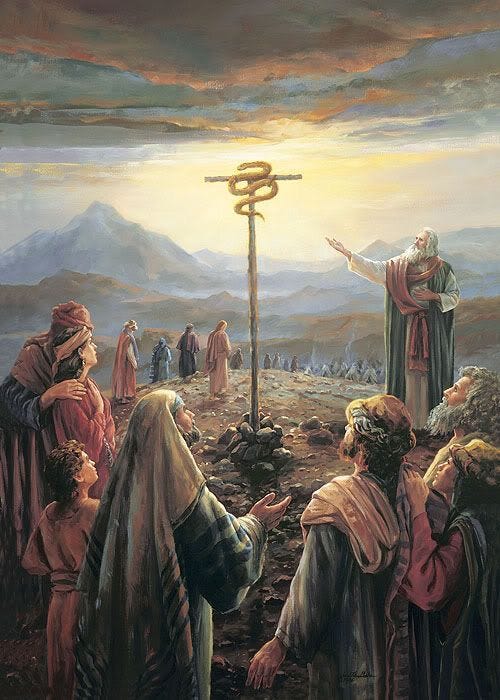
“Just as Moses lifted up the serpent in the wilderness, so must the Son of Man be lifted up” (John 3:14, NRSV).
Jesus is recalling the story of the bronze serpent in the wilderness in Numbers 21:4–9. The Israelites, in their sinfulness, had doubted and rejected their God, so as punishment, they were bitten by poisonous snakes, destined to die, with only one hope. Look at the bronze serpent on the pole, and you will be healed.
“By the figure of the serpent He taught that the remedy for the evil is not flight but the fixing of the eyes upon Him who was made in the likeness of sin.” — St. Gregory of Nyssa9
So too now the call for the Christian returns to where we started. We are dying of a terminal illness, and our only hope is to gaze at Christ crucified and believe in Him. The only requirement is to die to oneself in baptism because it is in the paradox of the waters of baptism that symbolise both death and new life that we commit ourselves to live as receivers of life and not the authors of it.
To live after baptism is to live in a world still organized around desire, reputation, and self-creation while belonging to a kingdom formed by gift. The Cross remains lifted before us because original sin always tempts us to become authors of our own lives again.
And yet Scripture does not leave us only with struggle. The same God who exposes the sickness promises His nearness within it: “The Lord is near to the brokenhearted, and saves the crushed in spirit” (Psalm 34:18, NRSV).
In Christ,
-Corné
Publication Update:
After some time of prayer and reflection, I have decided to enable paid subscriptions here. It was something I had been going back and forth about for a while, and I have finally found a way in which I feel comfortable doing so.
First: what this does not mean: nothing that has been freely given will be taken away. The bi-weekly essays will remain free. I have always wanted this space to be open to anyone who wishes to read, regardless of circumstance, and that will not change. The writing exists to be read, and I hope always to keep the door open to anyone who wishes to walk through it.
On the other hand, over the past year, many of you have asked how you could support the work more concretely — especially as I prepare for PhD studies, which require a real material investment. The paid tier is simply a way for those who desire to support the writing to do so, while also allowing me to share parts of the process that don’t quite belong in the public essays. The goal has always been to add value to my readers' lives, and I hope to continue doing so more with this paid tier. It is a way for people to support me and also to be formed at a fundamental level, not just in the ideas but in the process that births them. Also its only $7 a month, $70 for the annual subscription. If 20 of you subscribed for a whole year, it would pay for half of a year’s tuition. So, in the space of sharing this with vulnerability, I am opening up the space for people to support the work that I do, so that in return, I can continue to bless those who give their precious time to read my work.
This space will be more personal and conversational, closer to continuing the discussion in my study than publishing a finished piece.
Subscribers will receive:
• responses to reader questions and requested theological topics
• informal reflections — thoughts in progress rather than polished conclusions
• my current reading list and why I am reading each book
• short book reviews and recommendations
• early access to chapters and upcoming projects
• practical tips on studying, reading, and writing from my life as a student, teacher, and writer
Founding members will also be acknowledged in future self-published books as a sign of my gratitude for helping sustain the work at this stage.
The essays remain the front door.
This simply opens the study for those who would like to sit a while longer.
Thank you, as always, for reading.
I am pretty sure that if you want to upgrade your subscription, you can do so via the button above. This might not work in the App, so if you would like to upgrade your subscription, I know it works via desktop.
Other ways to support me are buying one of my books, which you can find by clicking the button below:
Pastoral note, the reason someone is battling illness and not receiving healing is not because of unrepentance; it can be the case, but use discernment. Do not hear what I am not saying.
Gilbert K. Chesterton, Orthodoxy. New York: John Lane Company, 1909. 24.
G. K. Chesterton, All Things Considered (New York: John Lane Company, 1909), 191–192.
Gilbert K. Chesterton, Heretics (New York: John Lane, 1919), 79.
St. Augustine Bishop of Hippo, The Confessions of St. Augustine, trans. E. B. Pusey (Oak Harbor, WA: Logos Research Systems, Inc., 1996).
The social contract is the idea that political authority and moral obligations in society arise from an implicit (or hypothetical) agreement among individuals to live together under shared rules for mutual benefit. Instead of power coming from divine right, tradition, or sheer force, society exists because people consent, at least in principle, to surrender some freedom in exchange for order, protection, and cooperation. This idea originates formally within the thought of John Locke and Thomas Hobbes.
Oscar Wilde, The Picture of Dorian Gray, (Collins Classics, 2010), 74.
Joseph Ratzinger, Principles of Catholic Theology: Building Stones for a Fundamental Theology, trans. Mary Frances McCarthy (San Francisco: Ignatius Press, 1987), 15–17.
St. Gregory of Nyssa, Life of Moses II
So good
🔥